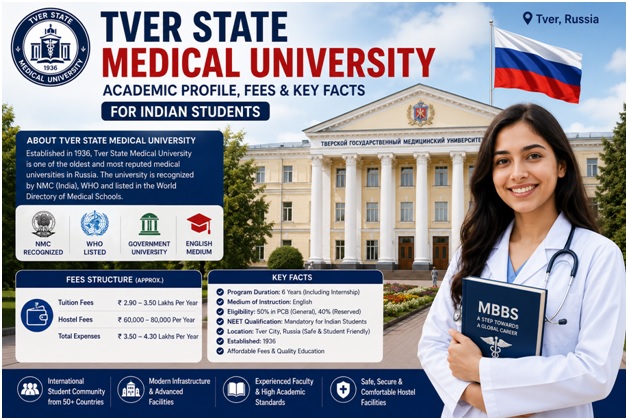
Russia attracts thousands of Indian medical students every year. Several universities in the country are well-established and widely recognized. Tver State Medical University is one of the names that comes up regularly in this space. This article covers its history, course structure, fees, and the facts students should verify before applying.
History and Location
The university was established in 1936 and is one of Russia’s oldest public medical institutions. It is located in Tver city, approximately 180 kilometres northwest of Moscow, making it easily accessible by road and rail.
The city of Tver has a history going back to 1135, when it served as a medieval capital and a historical rival to Moscow. Today it is a mid-sized regional city with a lower cost of living compared to Moscow or St. Petersburg. It is divided by three rivers and has a mix of neoclassical architecture, parks, museums, and modern amenities.
Recognition Status
The university is recognised by the National Medical Commission (NMC) of India, the World Health Organization (WHO), the Educational Commission for Foreign Medical Graduates (ECFMG), the Foundation for Advancement of International Medical Education and Research (FAIMER), and is listed in the World Directory of Medical Schools (WDOMS). This covers the primary approvals Indian students need to remain eligible for India’s licensing exam after graduation. Recognition statuses are reviewed periodically. Students should always confirm the current NMC list directly before applying.
Course Structure
The MBBS-equivalent programme runs for six years. This includes five years of academic and clinical coursework followed by a mandatory one-year internship. The programme is offered in English for international students, with Russian language training running alongside to support patient communication during clinical rotations in later years.
The university has affiliated hospitals providing clinical exposure across multiple departments, and the campus includes modern laboratories, libraries, and research facilities.
Fees: Current Figures
The annual tuition fee for the MBBS in Russia for this university is approximately RUB 4,30,000 per year. This is denominated in Russian Rubles, and the Indian Rupee equivalent will change with the exchange rate. Fees typically see incremental increases each academic year.
Hostel accommodation is available in multiple residential halls on campus. Rooms are generally shared between two to three students and include basic furnishings, internet access, heating, and air conditioning. Indian food is available in the hostel canteen. Students should ask for itemized hostel fee figures at the time of application, as these can vary depending on room type and block.
Beyond tuition and hostel, students should budget separately for medical insurance, visa extension charges, food, and personal expenses. Evaluating only the tuition figure gives an incomplete picture of the real six-year cost.
FMGE: Read This Carefully
This section deserves special attention. Many websites quote FMGE pass rates for Tver in the range of 18–28%. These figures come primarily from consultancy and admission websites, not from official examining bodies.
The National Board of Examinations (NBE) releases official institute-wise FMGE performance data periodically. Students comparing universities should source FMGE figures from the NBE’s official reports or the National Medical Commission’s records, not from third-party websites that have a commercial interest in promoting specific universities. Official data and marketing claims can differ significantly, and making a six-year commitment based on inflated figures is a serious risk.
Nationally, the FMGE December 2024 session recorded a pass rate of 29.62%, while the June 2024 session was 20.89%. University-specific figures vary considerably within this national range. Students should request verified, year-wise FMGE data for any specific university directly from the NBE report or from alumni who have appeared for the exam — not from admission representatives.
Life in Tver
There is an established Indian student community in Tver, with over 700 Indian students currently enrolled at the university. This can ease the initial adjustment period. The city is quieter than Moscow, which suits students who prefer a more focused study environment. Travel to Moscow is straightforward — trains run regularly and the journey takes one to three hours.
Final Word
Tver State Medical University has a long institutional history, broad international recognition, and an established Indian student presence. These are real positives. However, as with any MBBS abroad decision, the key factors to verify independently are the current NMC recognition status, the actual all-inclusive six-year cost, and — most importantly — FMGE performance figures from official NBE data rather than from promotional sources. A well-informed decision now will save significant difficulty later.